FOLLOW US ON TWITTER
SHARE THIS PAGE ON FACEBOOK, TWITTER, WHATSAPP ... USING THE BUTTONS ON THE LEFT


YOUR PARTICIPATION FOR THE GROWTH OF PHYSICS REFERENCE BLOG

Tuesday, February 3, 2015

Physics 9702 Doubts | Help Page 59

  • Physics 9702 Doubts | Help Page 59


Question 335: [Matter > Elasticity]
A long, thin metal wire is suspended from fixed support and hangs vertically. Masses are suspended from its lower end.
Load on the lower end is increased from zero and then decreased again back to zero.
Diagram shows the force-extension graph produced.
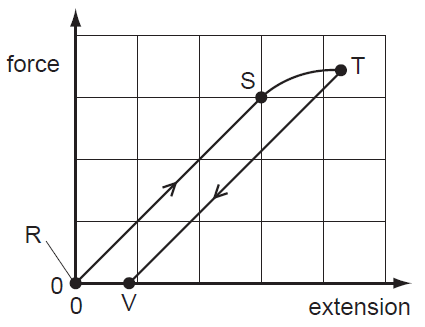
Where on graph would the elastic limit be found?
A anywhere between point R and point S
B beyond point S but before point T
C exactly at point S
D exactly at point T

Reference: Past Exam Paper – June 2011 Paper 11 Q20


Solution 335:
Answer: B.
The elastic limit is beyond the limit of proportionality.

Up to the limit of proportionality, the force is extension is proportional to the force – that is, the graph is linear. The limit of proportionality is exactly at S, so the elastic limit should be beyond S. [A and C are incorrect]

Up to the elastic limit, the wire would still behave elastically – that is, it regains its original shape when the deforming force is removed. Point T is therefore beyond the elastic limit since plastic deformation occurs when the force is reduced to zero. [D is incorrect]


Question 336: [Matter > Solids]
Stress-strain graphs for four different materials are shown below.
Which diagram shows stress-strain graph for a ductile metal?

Reference: Past Exam Paper – June 2013 Paper 11 Q22


Solution 336:
Answer: A.
Material that undergo plastic deformation before breaking are said to be ductile. So, the graph should go beyond the elastic limit.

Since it is for a metal, it should obey Hooke’s law up to some point – that is, a part of the graph should be a straight line. Then, beyond the limit of proportionality, the graph is no longer linear and beyond the elastic limit, plastic deformation occurs. [A is correct and C is incorrect]

Graph B is that of an amorphous solid, such as glass. It does not shown plastic behaviour (it is brittle) but instead would break when some stress is applied to it.

Graph D is that of a polymer (such as rubber). When the stress is removed, even if the shape of the graph is not the same, the material would still regain its original shape.


Question 337: [Nuclear Physics > Scattering experiment]
α-particle scattering experiment provided evidence for existence of a nuclear atom.
(a) State what could be deduced from fact that
(i) most α-particles were deviated through angles of less than 10°
(ii) a very small proportion of the α-particles was deviated through angles greater than 90°

(b) Fig shows path AB of an α-particle as it approaches and passes by a stationary gold nucleus.

On Fig, draw lines (one in each case) to complete the paths of α-particles passing by the gold nucleus when the initial direction of approach is
(i) along line CD,
(ii) along line EF.

Reference: Past Exam Paper – November 2004 Paper 2 Q7


Solution 337:
(a)
(i) The nucleus is small in comparison to the size of the atom.
(ii) The nucleus is massive / heavy / dense and is charged

(b)
(i) The line should be a symmetrical path and the deviation correct with respect to the position of the nucleus. The deviation should be less than in path AB

(ii) The deviation is greater than 90° and in the correct direction


Question 338:
Derive the escape speed.


Solution 338:
The gravitational potential energy of an object at a point is defined as the energy required to bring the object from infinity to that point.

The gravitational potential energy of a mass m on Earth is
– GMm / R
where M = mass of Earth, R = radius of Earth.

To bring an object from the surface of Earth to infinity, the same amount of energy is required.


Therefore, to launch a rocket of mass m from the Earth’s surface so that it escapes completely from the gravitational attraction of the Earth, the rocket must take off from Earth with
Kinetic energy ≥ GMm / R
½ mv2 ≥ GMm / R
v ≥ √(2GM / R)

The least speed required, i.e. v = √(2GM / R), for an object to escape completely from the Earth and never to return is known as the escape speed from the Earth.


Escape speed from the Earth = √(2GM / R)
But GM = gR2,           [from g = GM / R2]
Escape speed, v = √(2gR2 / R) = √(2gR) = √[2 (9.81) (6.4x10⁶)] = 11.2 kms-1


Reference: “Pacific Physics A Level” Volume 1, by POH LIONG YONG, pg 238 - 239


Monday, February 2, 2015

Physics 9702 Doubts | Help Page 58

  • Physics 9702 Doubts | Help Page 58


Question 332: [Matter > Solids]
Diagram shows the arrangement of atoms in a particular crystal.

Each atom is at corner of a cube.
Mass of each atom is 3.5 × 10⁻²⁵ kg. Density of the crystal is 9.2 × 10³ kg m–3.
What is the shortest distance between centres of two adjacent atoms?
A 3.8 × 10⁻²⁹ m           B 6.2 × 10⁻¹⁵ m           C 3.4 × 10⁻¹⁰ m           D 3.0 × 10⁻⁹ m

Reference: Past Exam Paper – June 2012 Paper 12 Q22 & June 2015 Paper 11 Q21


Solution 332:
Answer: C.
A cube has 8 corners (4 at the top and 4 at the bottom). Note that the centre of an atom is situated at a corner of a cube.

The shortest distance between the centres of two adjacent atoms is therefore the length of a side of the cube.

An atom can be considered to have a spherical shape.
{Now, you will need to imagine a cube in 3D. You really need to visualize this in 3D or else you won’t be able to understand the calculations. Try to draw what is being described below while you read.}
Consider a corner of a cube. Let it be one of the 4 top corners. Since the centre of an atom is placed at the corner, the upper half of the sphere (hemisphere) can be neglected. Now, only a section of the lower hemisphere would be inside the cube. This section is actually 1/8 of a whole sphere.

The volumes of atoms inside a cube would actually look like this:


At each corner, 1/8 of the volume of a sphere (that is, 1/8 of an atom) is inside the cube. Since there are 8 corners, the total number of atoms inside the cube is 8 (1/8) = 1 atom.

The density of any single cube in the lattice is the same as the density of the whole lattice.

As explained, a cube contains a total of 1 atom inside it. So, when considering the density of a cube, we only need to consider the mass of 1 atom.

Density = mass / volume
Volume of a cube = mass of 1 atom /density = (3.5x10⁻²⁵) / 9.2 x 103 = 3.8x10⁻²⁹ m3

The shortest distance between the centres of 2 adjacent atoms is equal to the length of a side of the cube.

Length of cube = (3.8x10⁻²⁹)1/3 = 3.40x10⁻¹⁰m


Question 333: [Pressure > Liquids]
A tube is arranged as a siphon in a beaker of liquid. The point A is 60mm above the free surface if the liquid and B is 20mm below it. The tube is first filled with liquid and the end B is closed with a finger.

Find the amounts by which the pressures at A and B are above or below atmospheric pressure. When the finger is removed from B, liquid runs out. Why is this? When will the flow stop?
(Density of liquid = 0.9x10³ kgm-3; take the acceleration of free fall, g as 10 ms-2.)

Reference: “Pacific Physics A Level”, Volume 1, by POH LIONG YONG, pg 135 Example 7.3


Solution 333:
Let hA and hB be the heights of points A and B above and below the normal water surface, respectively.
{Remember that the tube is first filled with liquid and the end B is closed with a finger.}
If pA = pressure at A, then
{Atmospheric pressure acts at the surface of the liquid in the beaker. Since end B of the tube is closed with a finger, the system is in a state of equilibrium.
The equation below gives us the pressure acting at the level of the liquid surface. The pressure inside the tube acting at the level of the liquid surface should be equal to the outside atmospheric pressure acting on the liquid surface in the beaker.
In addition to the pressure at pA, the column of liquid inside the tube, below A, exerts some pressure at the level of the liquid surface.}
pA + hAρg = atmospheric pressure, po
pA = po – hAρg 
pA = po – (6.0x10⁻³) (0.9x10³) (10) = po – 5.4x10² Pa
Pressure at A = 5.4x10² Pa below atmospheric pressure

{The equation below now gives us the relationship of the pressure at the level of end B (unlike the equation above which gives us the relationship of pressures at the level of the liquid in the beaker).
The pressure at B acts on the finger. This is equal to the sum of the atmospheric pressure and the pressure due to the column of liquid from the level of the liquid above the level of end B.}
Pressure at B = po + hBρg
Pressure at B = po + (20x10-3) (0.9x10³) (10) = po + 1.8x10² Pa
Pressure at B = 1.8x10² Pa above atmospheric pressure
{The finger also exerts the same pressure at B, causing the system to be in equilibrium.}


{When the finger is removed, the finger no longer exerts a pressure on the liquid inside the tube. Instead, the pressure acting against the liquid in the tube at end B is now the atmospheric pressure. The system is no longer in equilibrium}
When the finger is removed from B, liquid runs out because the pressure inside the tube at B is greater (which is the value calculated above) than the pressure outside, the atmospheric pressure (when the finger is removed, the outside atmospheric pressure now acts at end B of the tube while the liquid inside the tube at end B still has the pressure calculated above – which is greater than the atmospheric pressure).
{So, the resultant pressure goes outside. So, the liquid, which was already in the tube (as stated in the question) moves out of the tube at B.}

The flow will stop only when the liquid level in the beaker comes down to the level of B. {When the liquid comes down to the level of B, there is no longer any column of liquid from the level of the surface of the liquid in the beaker above end B. That is, hB = 0. So, pressure at B = atmospheric pressure. Since the pressure at the surface of the liquid in the beaker is also the atmospheric pressure, the net difference in pressure is zero. So, the liquid stops flowing out.}


Question 334: [Matter > Young modulus]
Which property of metal wire depends on its Young modulus?
A ductility
B elastic limit
C spring constant
D ultimate tensile stress

Reference: Past Exam Paper – June 2012 Paper 11 Q23


Solution 334:
Answer: C.
Young modulus, E = stress / strain

Stress = Force / Cross-sectional area = F / A
Strain = extension / original length = e / L

E = (F/A) / (e/L) = FL / Ae

Hooke’s law: F = ke    where k is the spring constant

Since a metal wire obeys Hooke’s law up to some limit, the spring constant depends on the force, which can be found in the formula for the Young modulus.
E = (ke)L / Ae = kL / A

So, the spring constant, k depends on Young modulus E, original length L and cross-sectional area A.

For the above equation to hold, the metal wire should obey Hooke’s law. Hooke’s law is obeyed up to the limit of proportionality. Since the elastic limit and the ultimate tensile strength are beyond the limit of proportionality, these properties of the metal wire do not depend on its Young modulus. [B and D are incorrect]

Material that undergo plastic deformation before breaking are said to be ductile. Materials that obey Hooke’s law undergo elastic deformation – that is, they regain their original shape when the deforming force is removed. [A is incorrect]


Currently Viewing: Physics Reference |