FOLLOW US ON TWITTER
SHARE THIS PAGE ON FACEBOOK, TWITTER, WHATSAPP ... USING THE BUTTONS ON THE LEFT


YOUR PARTICIPATION FOR THE GROWTH OF PHYSICS REFERENCE BLOG

Wednesday, November 6, 2019

A crane has an arm to which is attached a frictionless pulley. A cable passes over the pulley and supports a load of 10 kN as shown.


Question 12
A crane has an arm to which is attached a frictionless pulley. A cable passes over the pulley and supports a load of 10 kN as shown.


The crane arm exerts a force F on the pulley.

What is the value of F ?
A 5.0 kN                      B 8.7 kN                      C 10 kN                       D 17 kN


Reference: Past Exam Paper – March 2016 Paper 12 Q2


Solution:
Answer: D.

The force of 10 kN in the cable and the load of 10 kN both have a component along the crane arm.

The force F exerted by the crane arm on the pulley is the sum of these 2 components.

Component of force in cable along the crane arm = 10 cos 30°
Component of load along the crane arm = 10 cos 30°


Considering the forces on the pulley,
F = 10 cos 30° + 10 cos 30°

Force F = 17.32 kN = 17 kN

Monday, November 4, 2019

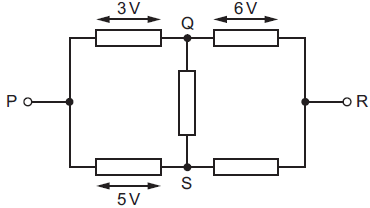
There is a current from P to R in the resistor network shown. The potential difference (p.d.) between P and Q is 3 V.


Question 32
There is a current from P to R in the resistor network shown.


The potential difference (p.d.) between P and Q is 3 V.

The p.d. between Q and R is 6 V.

The p.d. between P and S is 5 V.

Which row in the table is correct?


Reference: Past Exam Paper – June 2016 Paper 11 Q35


Solution:
Answer: A.

Current flows from P to R.

Recall that current cannot flow in opposite directions in the same wire.


There are different paths that the current could possibly flow.
Path 1: P to Q to R
Path 2: P to Q to S to R
Path 3: P to S to R
Path 4: P to S to Q to R


The p.d. between P and R is constant. This means that the sum of p.d. in any of the paths should be the same.

Let the p.d. between Q and S be QS and the p.d. between S and R be SR.

Considering the different paths,
Path 1: p.d between P and R = 3 + 6 = 9 V

Path 2: p.d. between P and R = 3 + QS + SR
The sum of p.d. in path 2 should also be 9 V as the p.d. between P and R is constant.
3 + QS + SR = 9
QS + SR = 9 – 3 = 6
QS + SR = 6               eq (1)

Path 3: p.d. between P and R = 5 + SR = 9
SR = 9 – 5 = 4 V
Substituting SR = 4 V in eq (1),
QS + 4 = 6
QS = 6 – 4 = 2 V


Path 4 may not be a possible path as the sum of p.d. is different.

Friday, November 1, 2019

A uniform diving-board is held by two fixed rods at points P and Q. A person stands at end R of the diving-board, as shown.


Question 32
A uniform diving-board is held by two fixed rods at points P and Q. A person stands at end R of the diving-board, as shown.


The forces exerted by the rods on the board are vertical. The board remains in equilibrium as the person slowly moves towards point Q from end R.

Which row describes the changes to the forces exerted by the rods on the board?

force at P                    force at Q
A         decreases                   decreases
B         decreases                   increases
C         increases                     decreases
D         increases                     increases


Reference: Past Exam Paper – June 2018 Paper 12 Q13


Solution:
Answer: A. 

For the board to remain in equilibrium, the resultant moment on it should be zero. That is, clockwise moment = anticlockwise moment.

The person’s weight acts downwards, causing a clockwise moment about the rods.

The rod at P exerts a downward force while the rod at Q exerts an upward force. Both of the forces causes a moment (in opposite direction) which balance the moment caused by the weight of the person.


We may take the pivot to be either at P or Q. When the pivot is taken to be at P, then the moment caused by the force at P is zero (as the perpendicular distance is zero). Similarly if the pivot is taken at Q, then the moment due to the force at Q is zero.

If the pivot is at P, the upward force at Q causes an anticlockwise moment. In the same way if the pivot is at Q, the downward force at P again causes an anticlockwise moment.


As the person moves towards the rods, the moment of the person’s weight at both P and Q decreases, and therefore the forces exerted by the rods at both P and Q must also decrease.
Currently Viewing: Physics Reference |